
Menu
What Is The Value of an Exchange?
What Is the Role of the Exchange Industry?
- The exchange industry plays a critical role in capital markets and the wider economy through three primary functions:
- capital formation,
- liquidity provision and price discovery;
- and risk management and transfer.
- Exchanges also operate as frontline regulators for financial markets.
- Exchanges' value to society rests on their ability to impact economic growth.
How Do Exchanges Help Capital Formation and Allocation in Primary Markets?
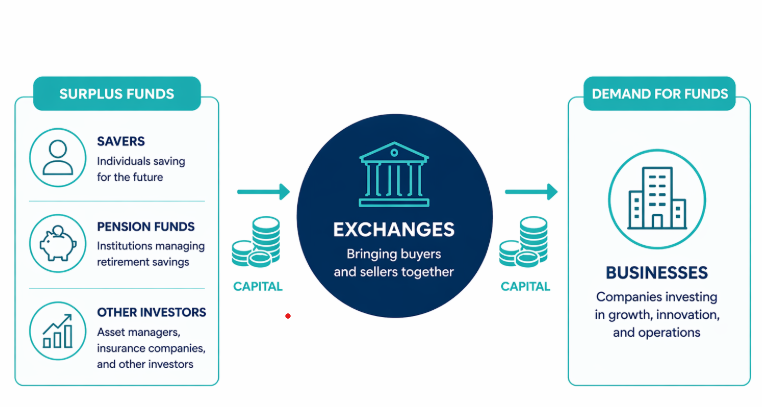
Firstly, exchanges facilitate the allocation of capital from those with surplus funds – such as savers, pension funds and other investors – to entities with demand for funds – such as businesses. In return, investors receive the opportunity to earn a return as a payment for the risk that they take. Capital intermediation is not unique to exchanges. However, their structure provides a distinctive mechanism for sharing returns across the economy. Investors are attracted to companies with proven success and strong potential. This directs capital towards the most promising businesses, helping them drive economic growth.
Media reports tend to focus on initial public offerings (IPOs), which are the first time that a private company sells shares of its stock to the public on a stock exchange. However, just as important and perhaps more important in some markets are secondary offerings, when a company sells additional shares of its stock after the IPO. For example, in the US in 2024, IPOs raised a total of $30 billion, while secondaries raised almost $170 billion.1 Exchanges also minimise risk which can help deliver financial stability. Exchanges prevent the buildup of risk in systemically important institutions by dispersing risks across investors. Furthermore, unlike banks, which can amplify downturns during a credit squeeze (procyclical), capital markets tend to be more stable. The fundamental reason is that exchanges channel existing savings towards existing or future investments of listed companies. This is because they are supported by investors with longer-term horizons, who are generally more willing to tolerate short-term risk.
How Do Exchanges Provide Liquidity and Price Discovery in Secondary Markets?
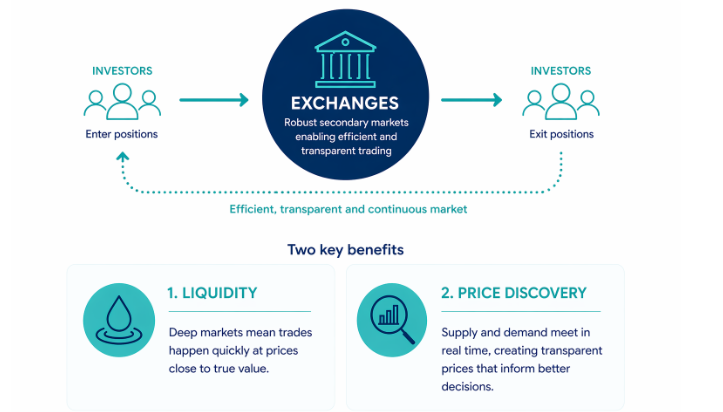
Exchanges operate robust secondary markets that enable investors to enter and exit positions efficiently and transparently. The effectiveness of these markets brings two huge benefits:
- Liquidity: By bringing together many buyers and sellers, an exchange ensures that trades can happen without delay and at prices close to the “true” current market value. Conceptually, liquidity means the ability to trade large volumes quickly without significantly impacting the price. This reduces the problem of finding a counterparty for a transaction and means that there is a buyer for every seller and a seller for every buyer.
- Price discovery: The exchange allows supply and demand to meet in real time. This results in transparent prices that reflect what participants collectively believe an asset is worth. This process is not just about a transaction price; the final price acts as a clear signal that collects valuable information about a company's health and future prospects. This signal helps investors and creditors make better decisions about where to allocate capital. This price discovery used by investors for decision-making, companies for funding and feedback and policymakers for managing the wider economy.
How Do Exchanges Enable Risk Management and Transfer?
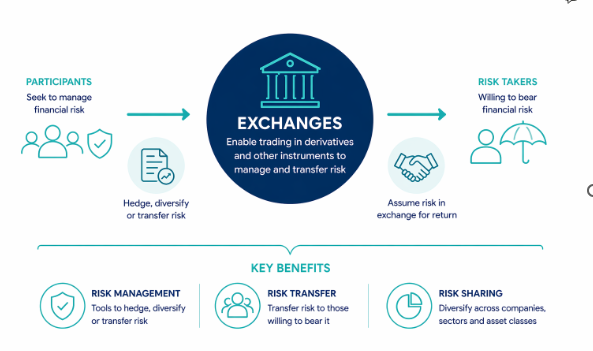
Finally, the exchange industry provides an effective method of risk management and risk transfer. By enabling trading in derivatives and other instruments, exchanges allow participants to hedge, diversify, or transfer financial risks to those willing to bear that risk. It also allows risk sharing for investors who can diversify their portfolios by investing variety of companies across different sectors or asset classes.
In all these activities, exchanges act as neutral and trusted third party. Exchanges (and the firms that trade on exchanges) operate under rules and oversight that give participants confidence that trades will be honoured. This reduces fraud and, together with central counterparties, reduces counterparty risk.
How Do Exchanges Regulate?
In many jurisdictions, exchanges are also expected to perform certain regulatory functions, such as regulating member brokers, conducting surveillance and disciplinary proceedings, setting listing standards and governance rules. Over time, in many countries these roles have been demutualised and we have seen the rise of independent regulators. However, it is still very relevant in many countries and this has helped build "trust" in the system.
What Value Does Society Derive from Exchanges?
Naturally, an exchange’s value to society principally rests on its ability to impact economic growth. Neo-classical economists would highlight an exchange’s role in facilitating the accumulation of capital – channelling resources from savers to productive investment as we cover above. A more endogenous approach places greater emphasis on the qualitative role played by exchanges. In this view, exchanges mobilise savings, promote entrepreneurship and increase the diffusion of innovation – thereby raising the long-term growth of the economy.
In the WFE’s Exchange Manifesto, we set out the ways that exchanges drive prosperity and deliver irreplaceable value to society. Namely, exchanges:
- Give people a path to financial security, via inflation-beating shares
They complete their offering with other products, such as fixed income. - Help companies – new and old, large or SME – to prosper
Listing is a platform for future funding, hiring and marketing – not just cash today. - Provide a clear signal on the health of a country
There is a mutually positive relationship with GDP increases. - By supporting growth, contribute indirectly to tax revenues
Also, financial services, with exchanges at the core, is a value-added industry. - Channel funds in the necessary scale to strategic sectors (defence, medicine)
Transitional and new sectors benefit too (digitalisation, AI). - Form the foundation for other financial markets
Exchanges have a "halo" effect, that makes other financial markets more credible. - Attract international investment
The profile and integrity of organised markets brings in foreign investors. - Underpin insurance
Insurers need to invest in growth and value assets and manage asset-price risk. - Promote public engagement
Access to capital markets and data reinforces social inclusion. - Ensure system-wide soundness and resilience
This is funding and investment, without credit crunches.
Exchanges are more than mere trading venues. Through the provision of liquidity, discovery of prices and in their trusted environment they channel savings into investments and support economic growth and social prosperity. In the next section we will look at their long history and see that, when they are well-run, exchanges underpin societal progress.
1 https://www.nasdaq.com/articles/markets-help-companies-finance-more-ways-one